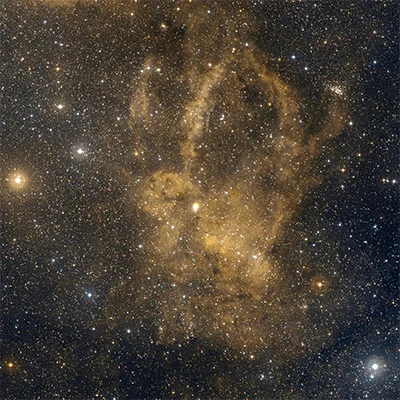
Open Cluster NGC 7419 + H-II Region Sh 2-154
Open Cluster NGC 7419
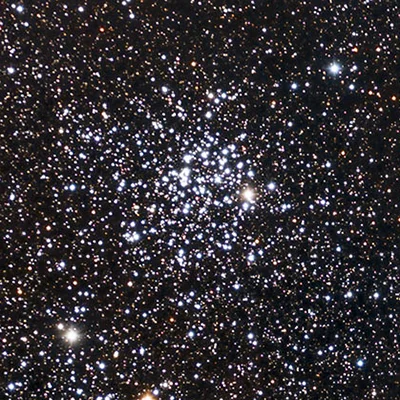
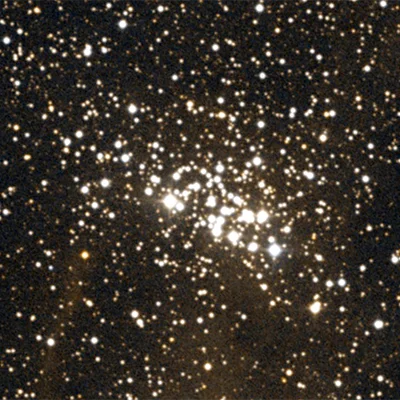
This open cluster was discovered by William Herschel on 3 November 1787. He classified it as seventh class (pretty much compressed clusters of large or small stars) and listed it as VII-43 with the description: «A small cluster of very small stars, considerably compressed and pretty rich.» [464] John Herschel observed the cluster twice and listed it as h 2190. He noted for sweep 214 (30 October 1829): «A small cluster of small stars 12 mag, diverging in a fan shape; a star 10 mag follows.» [466]
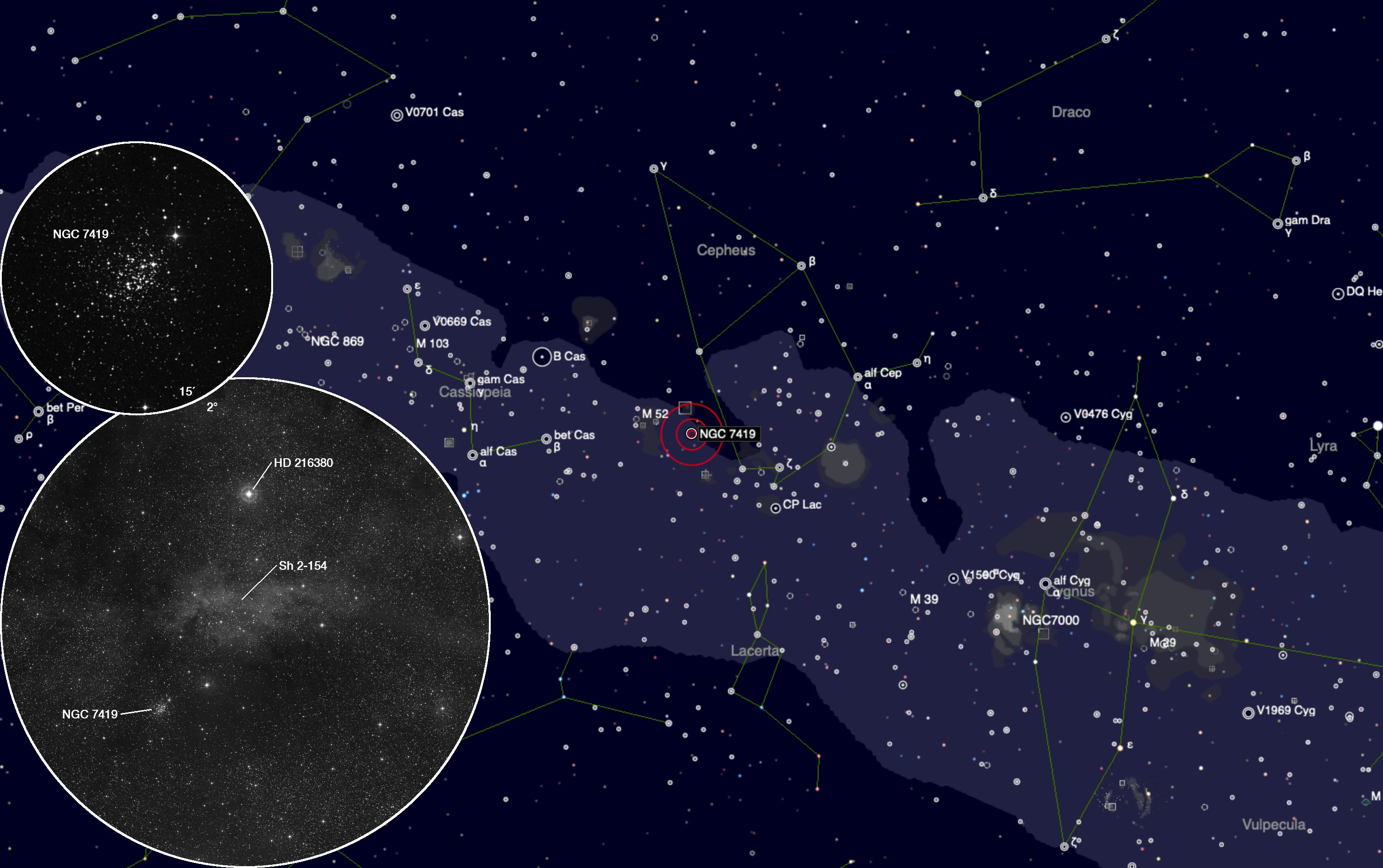
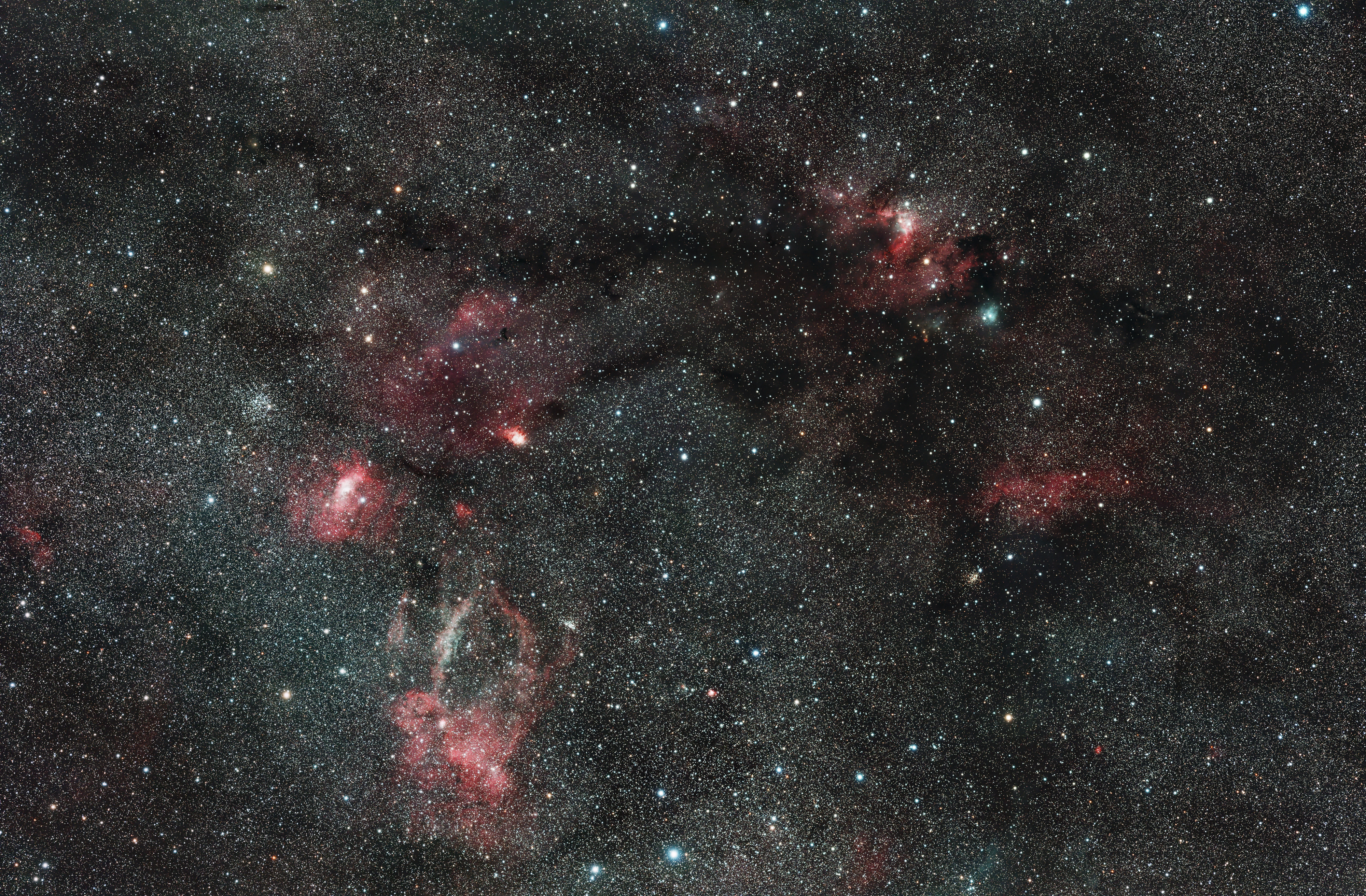
On images with long exposures (Fig. 1) one can see that the open cluster NGC 7419 is embedded in a dust cloud, which also connects to the nearby H-II region Sh 2-154. NGC 7419 is rich in Classical Be (CBe) stars and located at a distance of 2.9–4 kpc and has an estimated age of 21.1 million years. NGC 7419 also hosts five notable red supergiants. [761]
| Designation | NGC 7419 |
| Type | OCL (II3r) |
| Right Ascension (J2000.0) | 22h 54m 20.0s |
| Declination (J2000.0) | +60° 48' 56" |
| Diameter | 6 arcmin |
| Visual magnitude | 13.0 mag |
| Metric Distance | 1.382 kpc |
| Dreyer Description | Cl, pRi, cC |
| Identification, Remarks | WH VII 43; h 2190; GC 4864; OCL 250 |
H-II Region Sharpless 2-154
In 1959 the American astronomer Stewart Sharpless published a «Catalogue of HII Regions» discovered on the photo plates taken with the 48-inch Schmidt telescope for the «Palomar Observatory Sky Survey». He classified there Sh 2-154 with form 3 (irregular), structure 2 (between amorphous and filamentary), brightness 2 (medium), maximum diameter 60 arcminutes. He could not identify stars causing the nebula ionization. [310]
Finder Chart
The open cluster NGC 7419 and nebula Sh 2-154 are located in the constellation Cepheus. On 4 September it is in opposition to the Sun and culminates at local midnight.