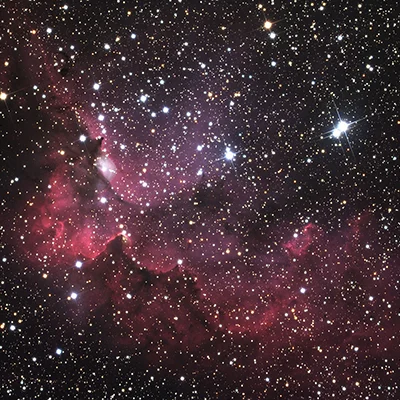
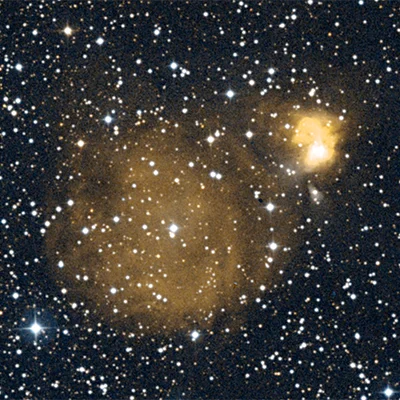
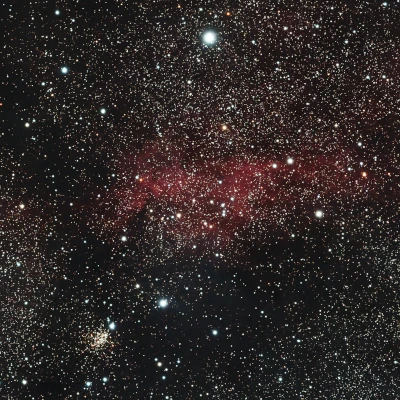
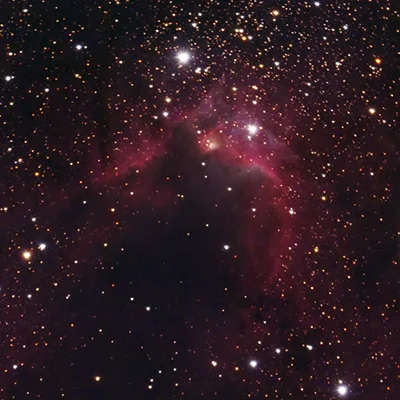
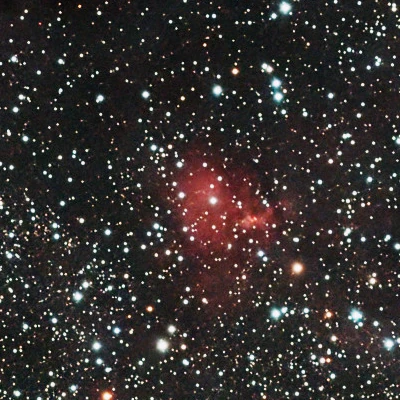
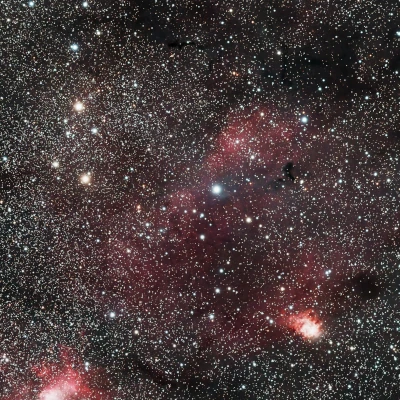
Lobster Claw Nebula (Sh 2-157)
History
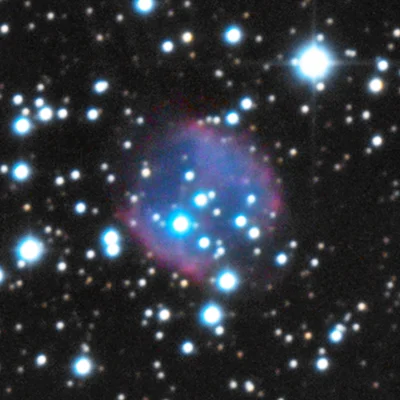
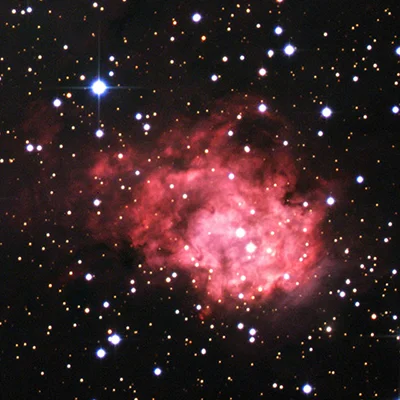
The diffuse nebula Min 1-103 was discovered in 1946 by the German-American astronomer Rudolph Minkowski. He detected objects with little or no continuous H-α spectrum on objective-prism survey plates obtained by W. C. Miller using the 10-inch telescope at Mount Wilson. Further examination of its appearance on direct photographs, taken at the Newtonian focus of the 60-inch or 100-inch telescope on Mount Wilson, revealed its nature as a planetary nebula. [397]
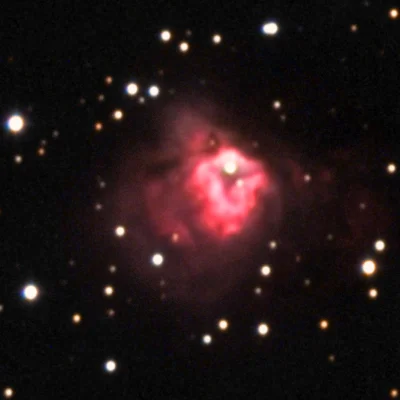
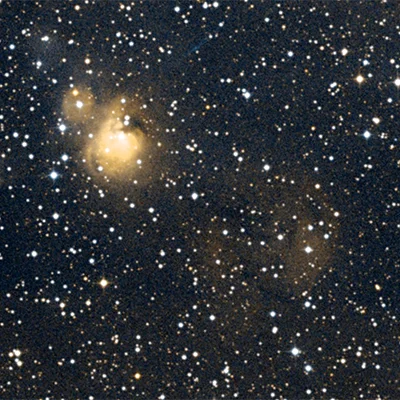
In the early 1950s, Russian astronomers Grigory Abramovich Shajn and Vera Fedorovna Gaze conducted an imaging survey of the Milky Way in the Hα hydrogen emission line using 640-mm and 450-mm (f/1.4) astrographs at the Simeis Observatory on the Crimean Peninsula. The large H-II nebulosity where (Min 1-103 is the brightest knot) were referred to as Simeiz 13 and 14 (also Simeis 13 and Simeis 14). [402]
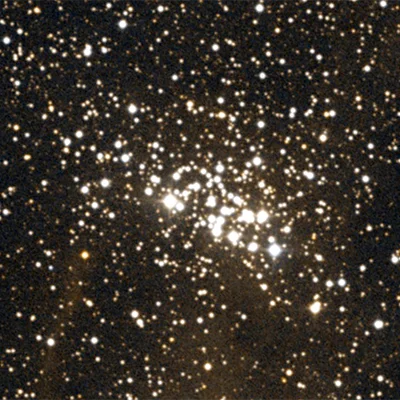
American astronomer Stewart Sharpless did a survey for H II regions on the photo plates of «Palomar Observatory Sky Survey» made with the 48-inch Schmidt telescope. In his first publication of 1953 the nebula was identified with Simeiz 13 and 14, listed as number 109 (Sh 1-109) with the notes: «Small cluster in center». [309] In 1959 he published a revised and extended version of his survey where the nebula got its designation Sh 2-157. [310]
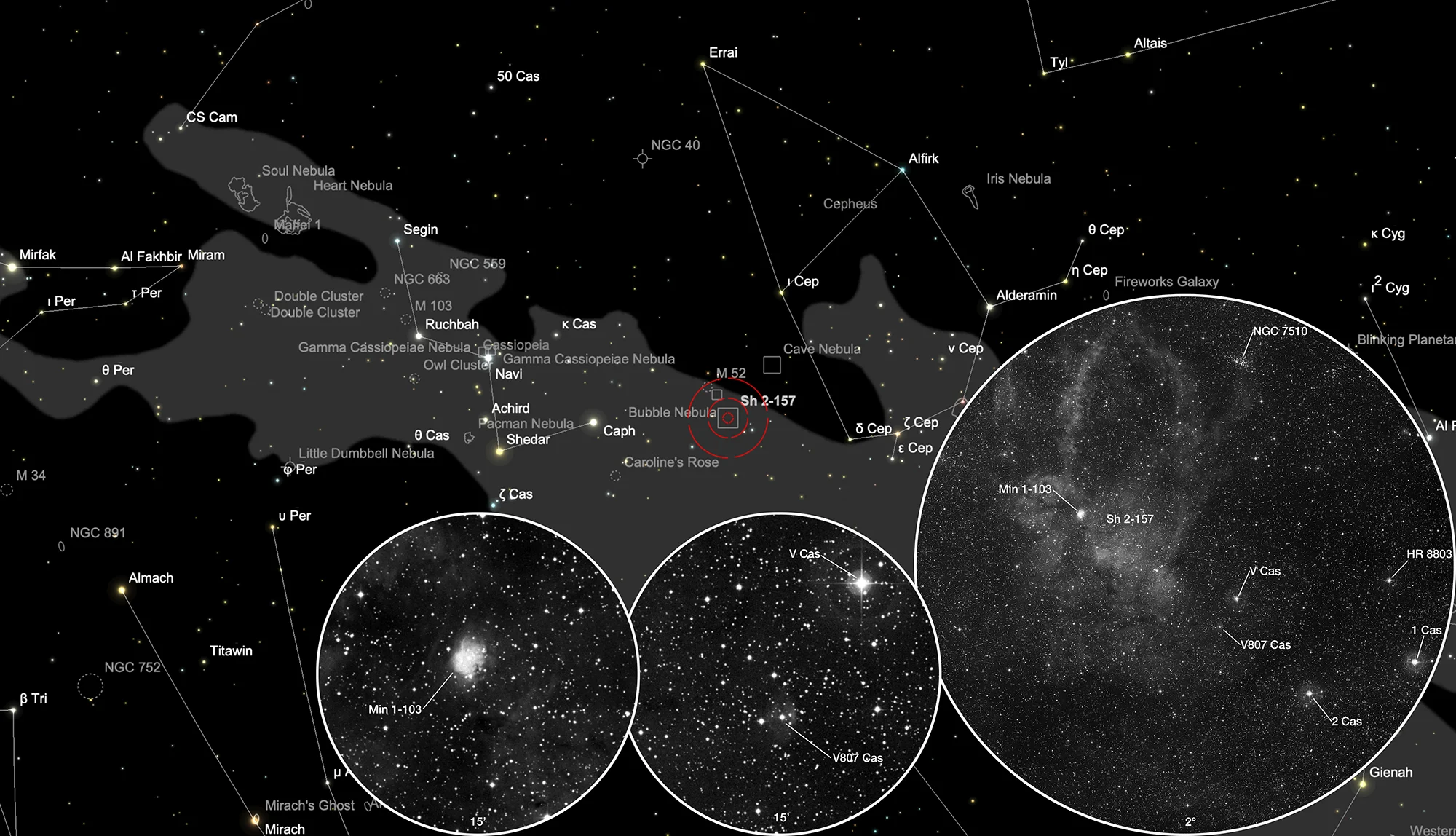
In 1977 Ronald Weinberger identified a 162x78 arcsecond sized, shell-like structure around variable star V807 Cassiopeiae and listed it as probable planetary nebula We 1-12 (PK 110-0.1). [749] A spectroscopic analysis conducted in 1985 by James B. Kaler and Walter A. Feibelman showed that the unusual bright central star does not show the typical spectrum of a planetary nebula nucleus, but that of a B0.5-B1 giant or supergiant, surrounded by a small H-II region. A distance of about three kpc was estimated. [750]
Physical Properties
V 807 Cas is an eclipsing binary star with a period close to two days. It is most likely the source of exitation of the H-II region named PK 110-0.1, which might be an outlier of the much lager H-II region Sh 2-157.[751]
| Name | Type | RA (J2000.0) | Dec (J2000.0) | PM [mas/y] | Parall. [mas] | SP Type | Size ['] | Magnitudes | Identifiers |
|---|---|---|---|---|---|---|---|---|---|
| Sh 2-157 | HII | 23h 16m 04s | +60° 02' 01" | 3.32 × 1.68 | GAL 111.28-00.66; GAL 111.28-00.67; GRS G111.20 -00.50; LBN 111.14-00.72; LBN 537; SH 1-109; SH 2-157; [ABB2014] WISE G111.286-00.660; [KC97c] G111.3-00.7; [UHP2009] VLA G111.2825-00.6634 | ||||
| Min 1-103 | ISM | 23h 16m 06s | +60° 02' 00" | Min 1-103 | |||||
| V* V807 Cas | El* | 23h 12m 13s | +59° 35' 59" | -3.641 | 0.3606 | B3 | U 10.62; B 11.13; V 10.8; G 10.728777; J 10.121; H 10.04; K 10.033 | 2MASS J23121298+5935590; ALS 12822; CSI+59-23101; GEN# +8.03590049; GSC 04010-00285; Gaia DR1 2013726271775593728; Gaia DR2 2013726276077656960; Gaia DR3 2013726276077656960; HIC 114552; HIP 114552; IRAS 23100+5919; IRCO 942; LS III +59 49; PK 110-00 1; PN We 1-12; TIC 323718023; TYC 4010-285-1; V* V807 Cas; [B53] 81 |
Finder Chart
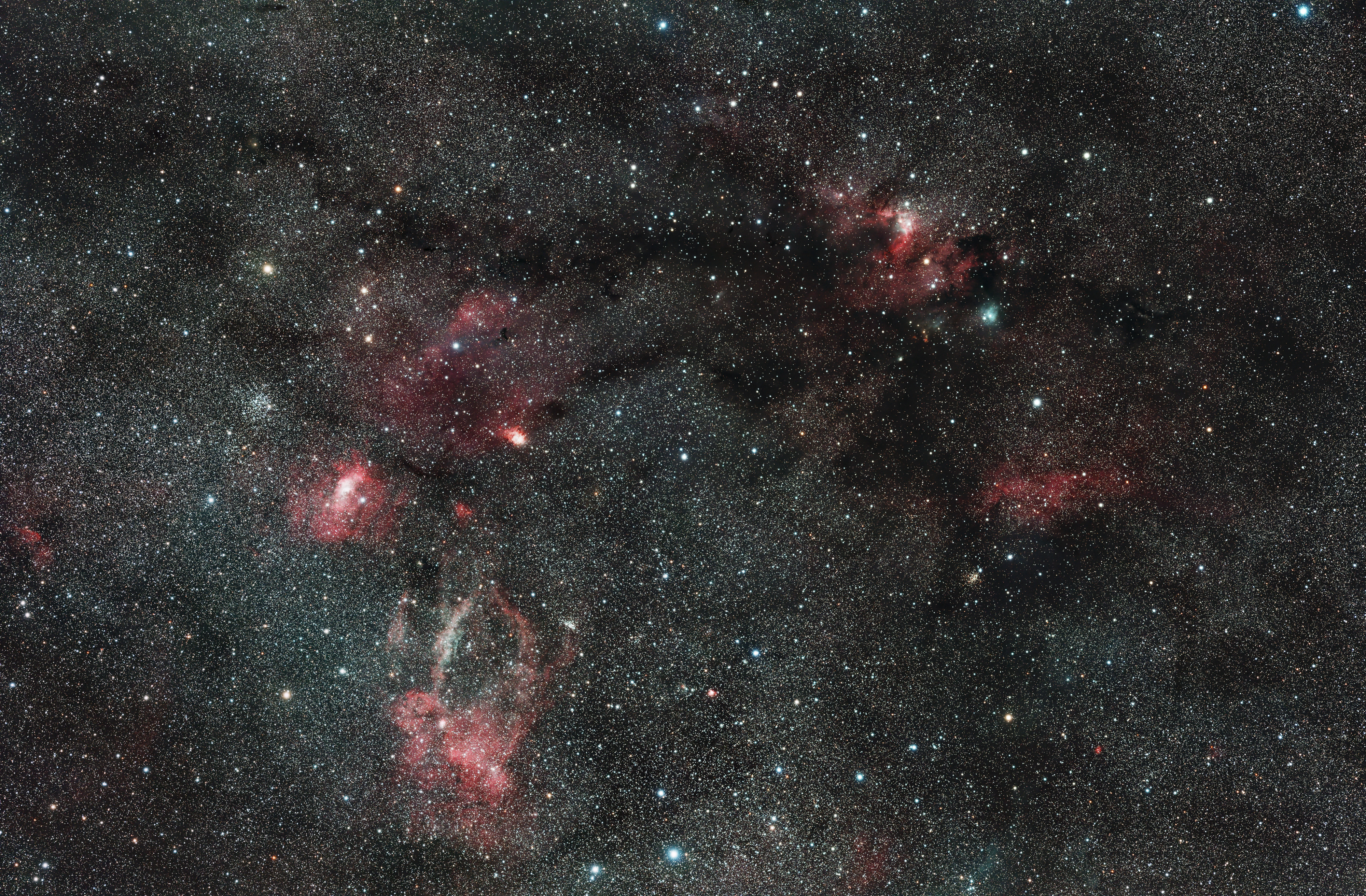
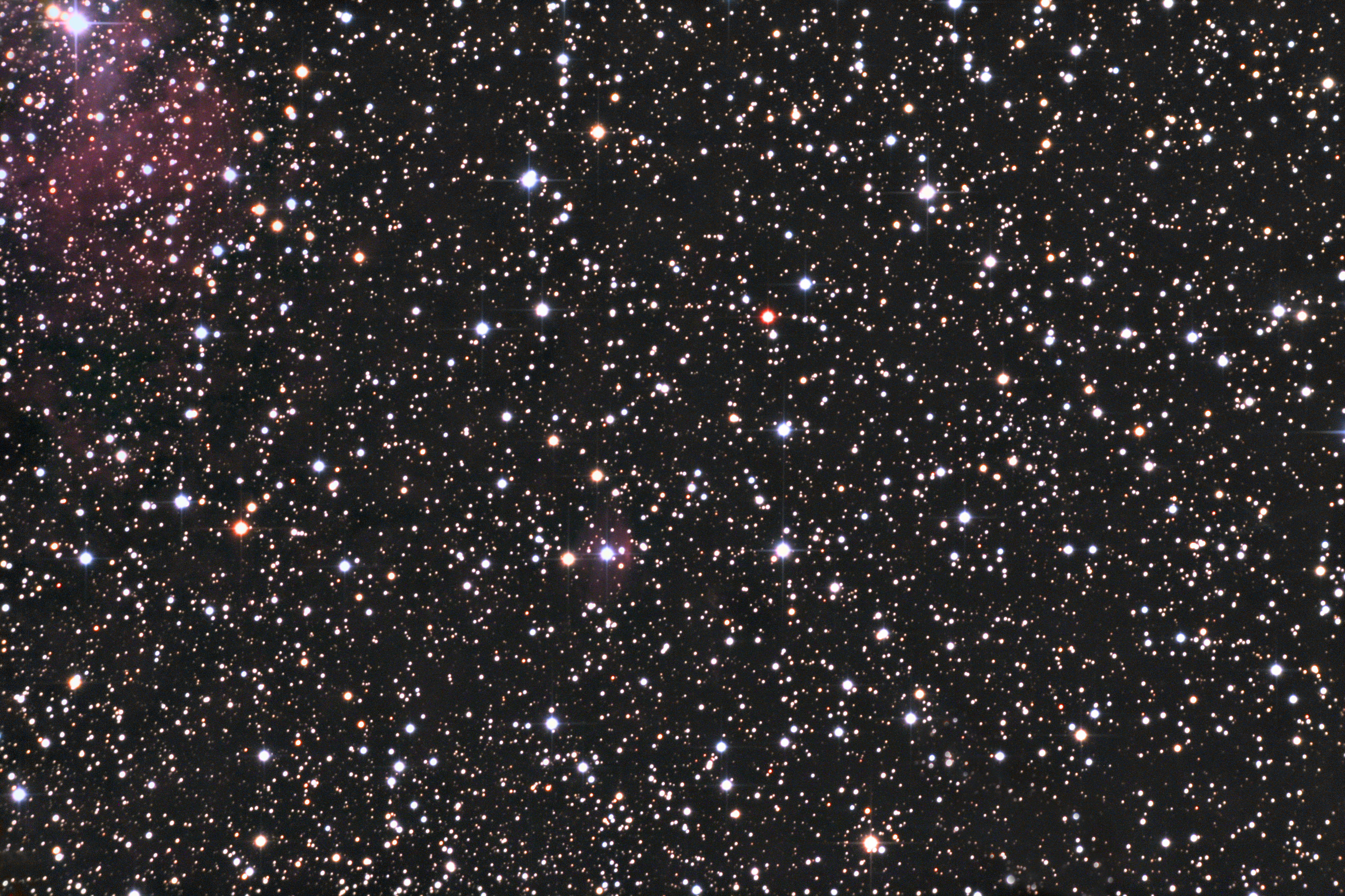
Sh2-157 is located in the constellation Cassiopeia, between the «W» of Cassiopieia and Cepheus. It is circumpolar for Central Europe. On 10 September it is in opposition to the Sun and culminates at local midnight.