Barnard's Loop (Sh 2-276)
History
This nebula was first mentioned by Wiliam H. Pickering. He discovered it on a photograph with a Voigtländer portrait lens of 2.6 inches (66 mm) aperture and 8.6 inches (218 mm) focal length and an exposure of 3 hours, taken in 1889 at Wilson's Peak (altitude 1905 m). He wrote: «An interesting structure brought out upon our plates is a large spiral nebula whose outer extremity starts in the vicinity of γ Orionis. It passes about four degrees north of ζ extends to [κ?] thence to β, then to η, with an outside stream lying nearly north and south, and preceding β about four degrees. nother stream lying nearly east and west precedes η about the same amount. This nebula is about seventeen degrees in length, by nearly the same breadth, and surrounds a cluster of bright stars including the belt and sword handle, and extending towards γ. The region containing the nebula is noticeably lacking in stars brigther than the eighth magnitude, but contains the very bright stars γ and β. It is possible that a plate with double our present exposures, which we are soon going to try, will fil the space between η and ζ, thus making the great nebula the inner termination of the spiral. This nebula is shown by three different exposures and is very distinctly marked.» [755]
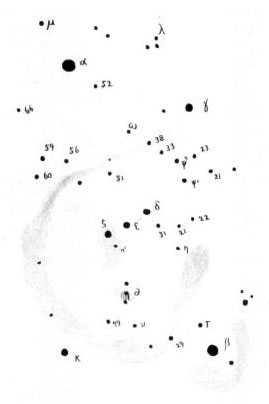
On 3 and 24 October 1894 Edward Emerson Barnard made two photographs (2h and 1h 15m) using his «lantern lens», a small, short-focus lens of 1.5 inch (38 mm) diameter, 3.5 inches (89 mm) focal length (f/2.3) and about ~30° field of view. He wrote: «To my surprise these pictures showed an enormous curved nebulosity encircling the belt and the great nebula, and covering a large portion of the body of the giant [Orion].» After he had made the drawing and partially written the paper he remembered that «Professor W. H. Pickering had once spoken of a great nebula shown on his photograpsh of Orion and previously unknown.» He then quoted Pickering's article section. [756]
In 1959 Stewart Sharpless listed the Barnard Loop as Sh 2-276 in his «Catalogue of H-II Regions» and noted: «The Barnard Loop. Several detached portions to NE and SW.» [310]
Physical Properties
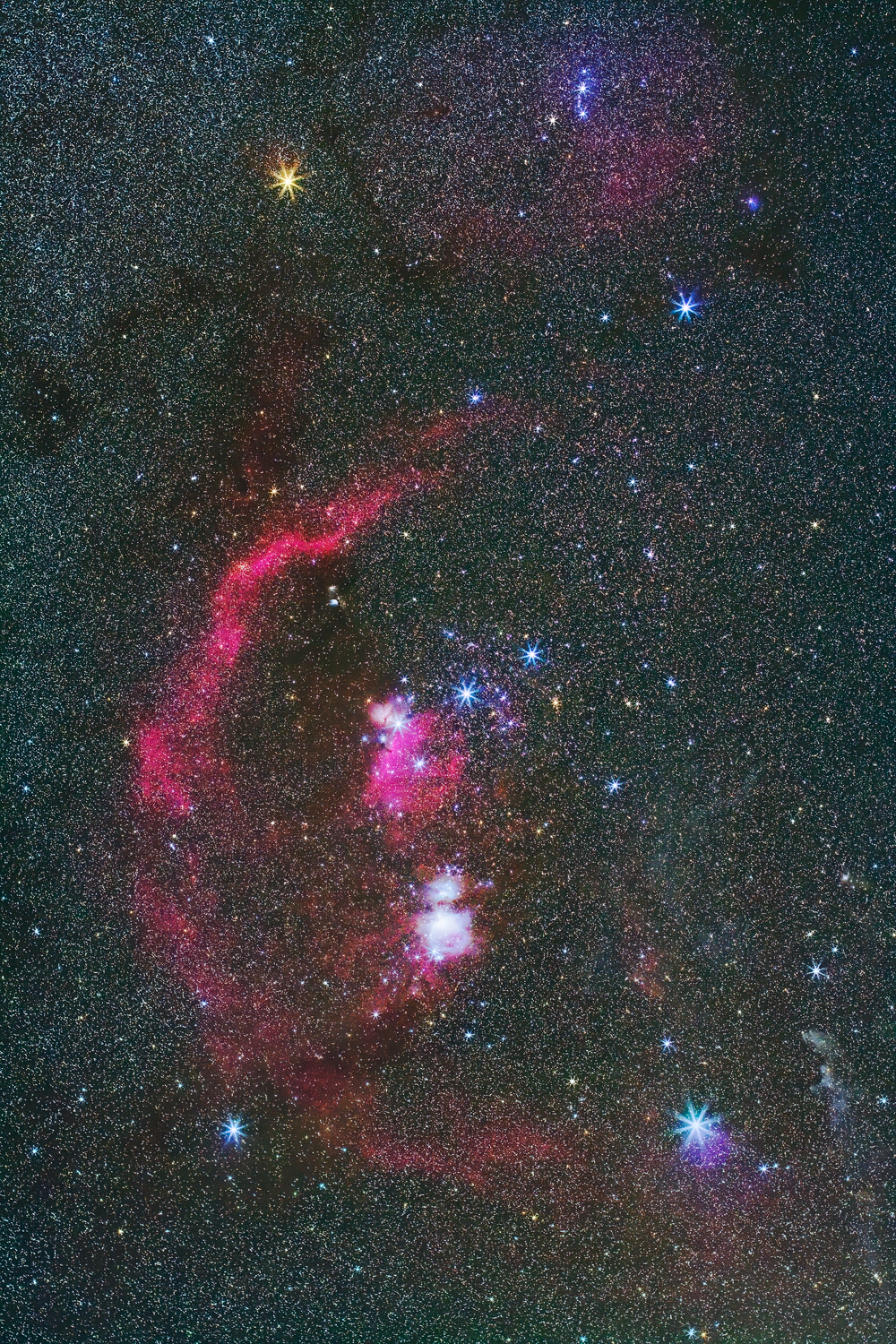
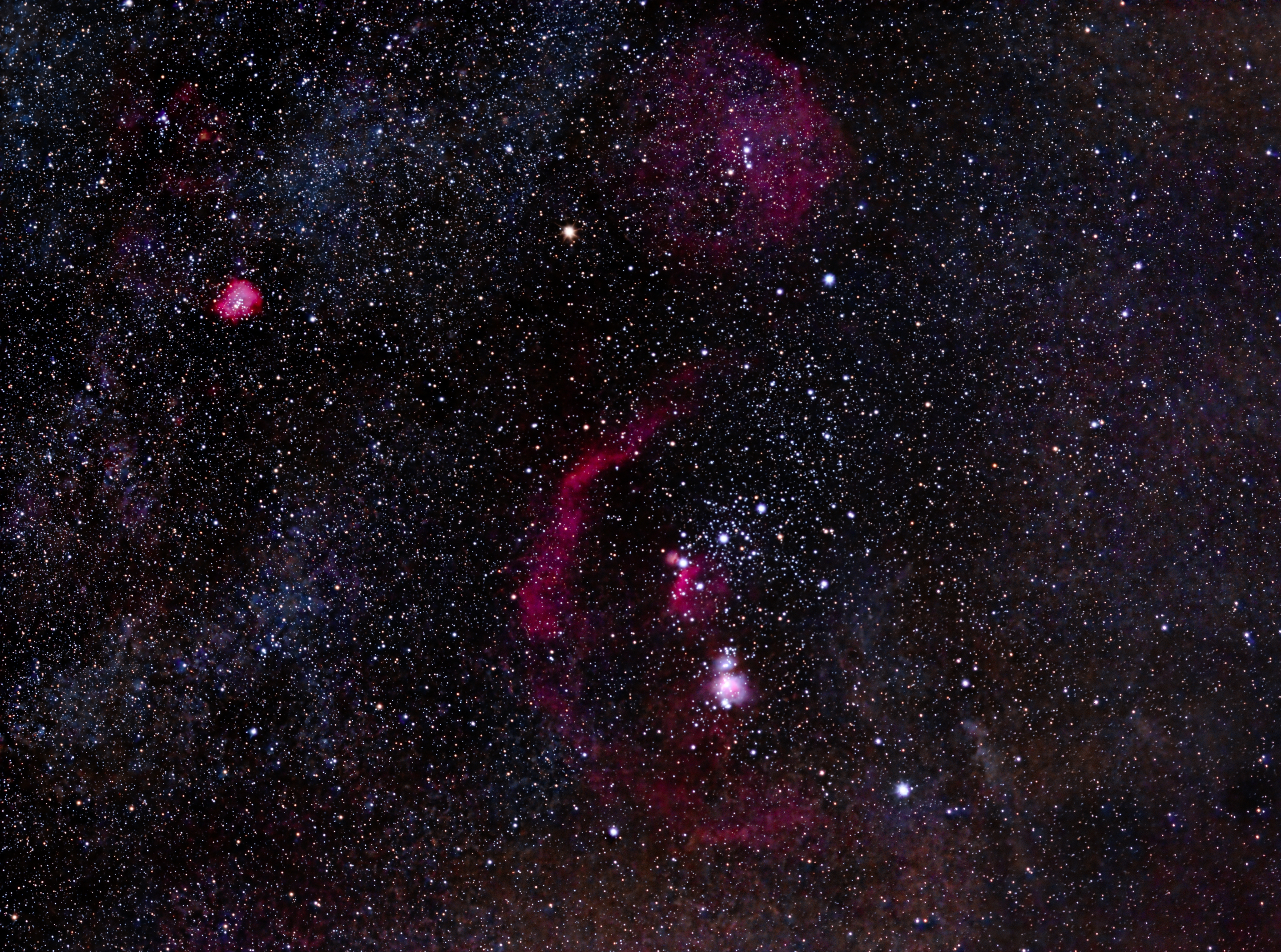
Barnard’s Loop is a large, roughly 14° wide arc of Hα emission located in the Orion complex, a star-forming region, located roughly 400–430 pc from the Sun and spanning over 200 square degrees on the sky. This region is home to one of the largest and best-studied associations of O and B stars, the so-called Orion OB1 association. Barnard’s Loop has an estimated physical radius of ~50 pc. Its morphology is best explained by the combined effects of stellar winds and many supernova explosions occurring over past 12 million years, rather from a single catastrophic event. [757]
Finder Chart
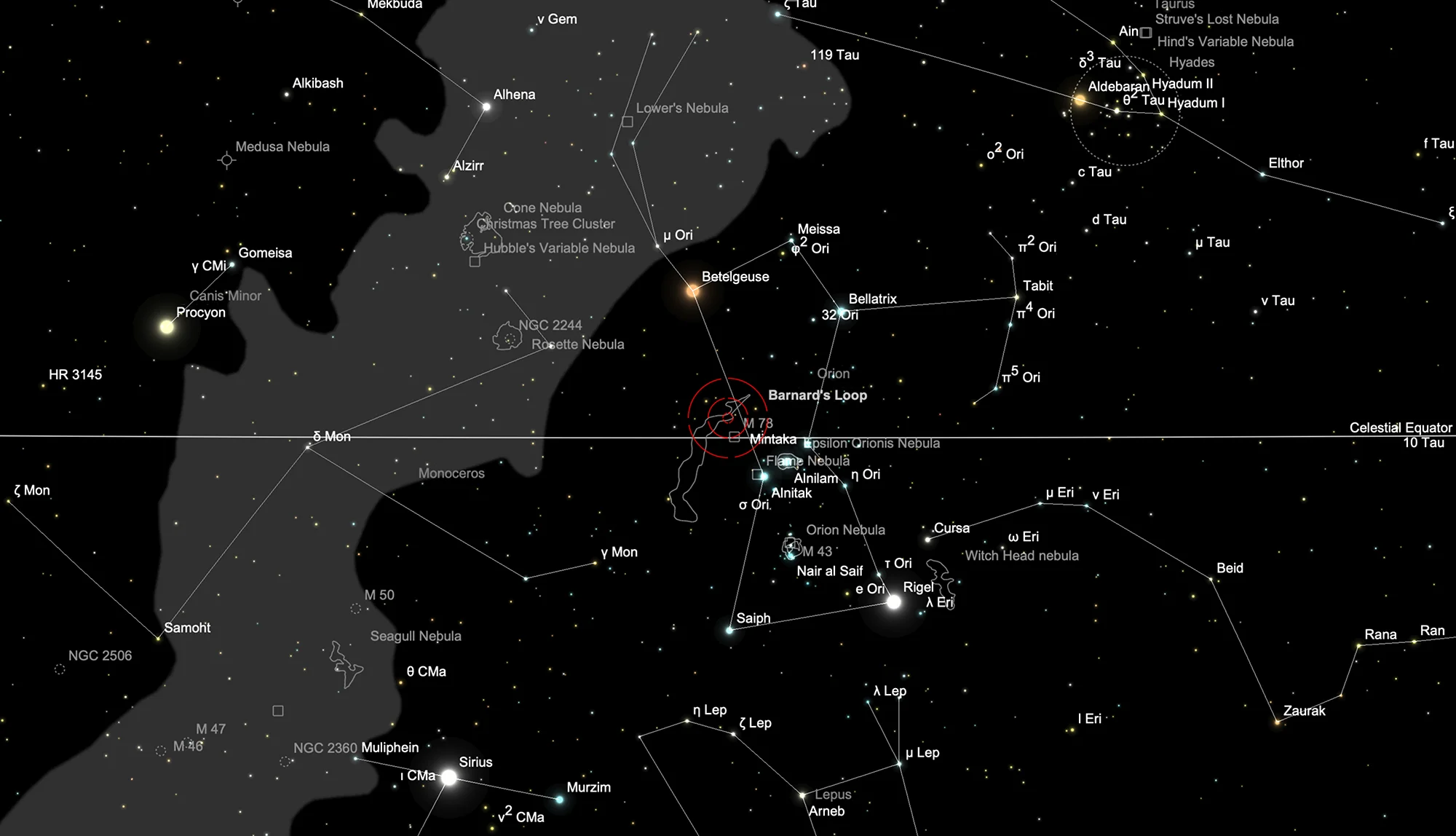
The Barnard's Loop (Sh 2-276) is located in the constellation Orion with the most brightest part east of the constellation figure. At about 14 December they are in opposition to the Sun and crosses the meridian at local midnight.