Planetary Nebula HDW 2
While searching the photo plates of the «Palomar Observatory Sky Survey» made with the 48 inch Schmidt telescope, the American astronomer Stewart Sharpless came across this faint nebula, classified it as a HII nebula and listed it as Sh 2-200 in his «Catalogue of HII Regions», published in 1959. [310] In 1965 Beverly T. Lynds added the nebula Sh 2-200 as LBN 138.18+04.11 (LBN 674) in her «Catalogue of Bright Nebulae». [270]
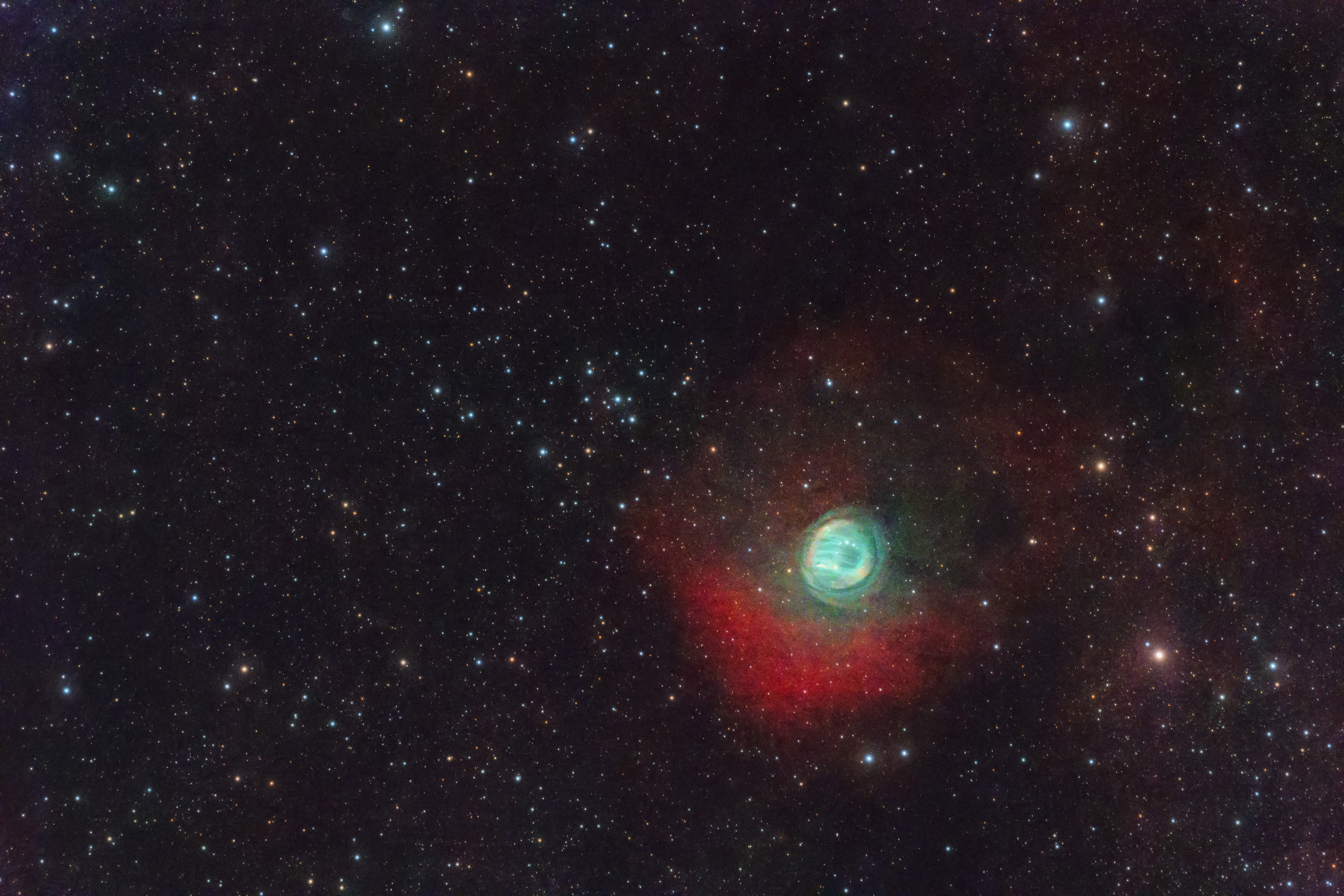
The true nature of this nebula was first doubted in 1983 by H. Hartl, J. Dengel and R. Weinberger from the Innsbruck Institute of Astronomy. They did a survey of the POSS photo plates, searching for old planetary nebulae. They found 13 new candidates for planetary nebulae, among them this one, listed as second entry, found on POSS plate 968. The designation of this planetary nebula is HDW 2 (Hartl-Dengel-Weinberger 2) [764] In a 1987 publication by Hartl and Weinberger they described it as follows: «This object, listed as Sharpless 200, appears as a relatively large, slightly deformed ring in E, fainter and more disk-like in O. Most remarkably, there appears to be an extended halo around the PN with a diameter six times as large as the central nebula; note that the halo's size would then amount to 0.4°, that is 4 pc at a distance of 580pc! The brightest part of the southeast of the halo ha sa red surface brightness of only ~24.5mag. Although there is no visible blue central star, we suggest that this is aPN due to its enormous brightness in [OIII] according to the Emission Line Survey of Parker et al. (1979); the halo, however, is not detectable there. A detailed study of nebula and halo is needed.» [765]
Open Cluster Trumpler 3
The open cluster Trumpler 3 was catalogued by Robert. J. Trumpler in 1930 during his survey of Milky Way photographs by Barnard. He listed it as An. 3 with an angular diameter of 17 arcminutes and of class II 3p (II = detached cluster with little central concentration, 3 = composed of bright and faint stars, p = poor, less than 50 stars) with an adopted distance of 690 parsecs. He remarked that the cluster was first mentioned by Barnard (Bd. Atl. pl. 2) as a «very loose open cluster, not rich, but regular in outline and structure.» [712]
The Swedish astronomer Per Collinder listed the star cluster under the number 36 in his «Catalog of Open Galactic Clusters» published in 1931. He described the cluster as «Irregular form, crescent, or triangle with offshoots.» [455]
A photometric and spectroscopic study estimates the age of the cluster to 70 ± 10 million years, a distance of 0.69 ± 0.03 kpc and the limiting radius of 12 arc minutes. The total number of members is estimated to 570 ± 90 stars with a total mass of the cluster to be 270 ± 40 times the mass of the Sun. Trumpler 3 is a young low-massive stellar ensemble with a typical mass function slope, located near to the outer edge of the Galaxy's Orion Spur. [763]
| Name | Cl Trumpler 3 |
| Object Type | Open Cluster |
| Right Ascension (J2000.0) | 03h 12m 01s |
| Declination (J2000.0) | +63° 13' 05" |
| Parallaxes | 1.461 mas |
| Radial velocity | -22.805 km/s |
| Redshift z | -0.000076 |
| Angular size | 33.1' × 33.1' |
| Magnitudes | V 7 |
| Identifiers | C 0307+630; Cl Harvard 1; Cl Trumpler 3; [KC2019] Theia 127; [KPR2004b] 40; [KPS2012] MWSC 0262 |
Finder Chart
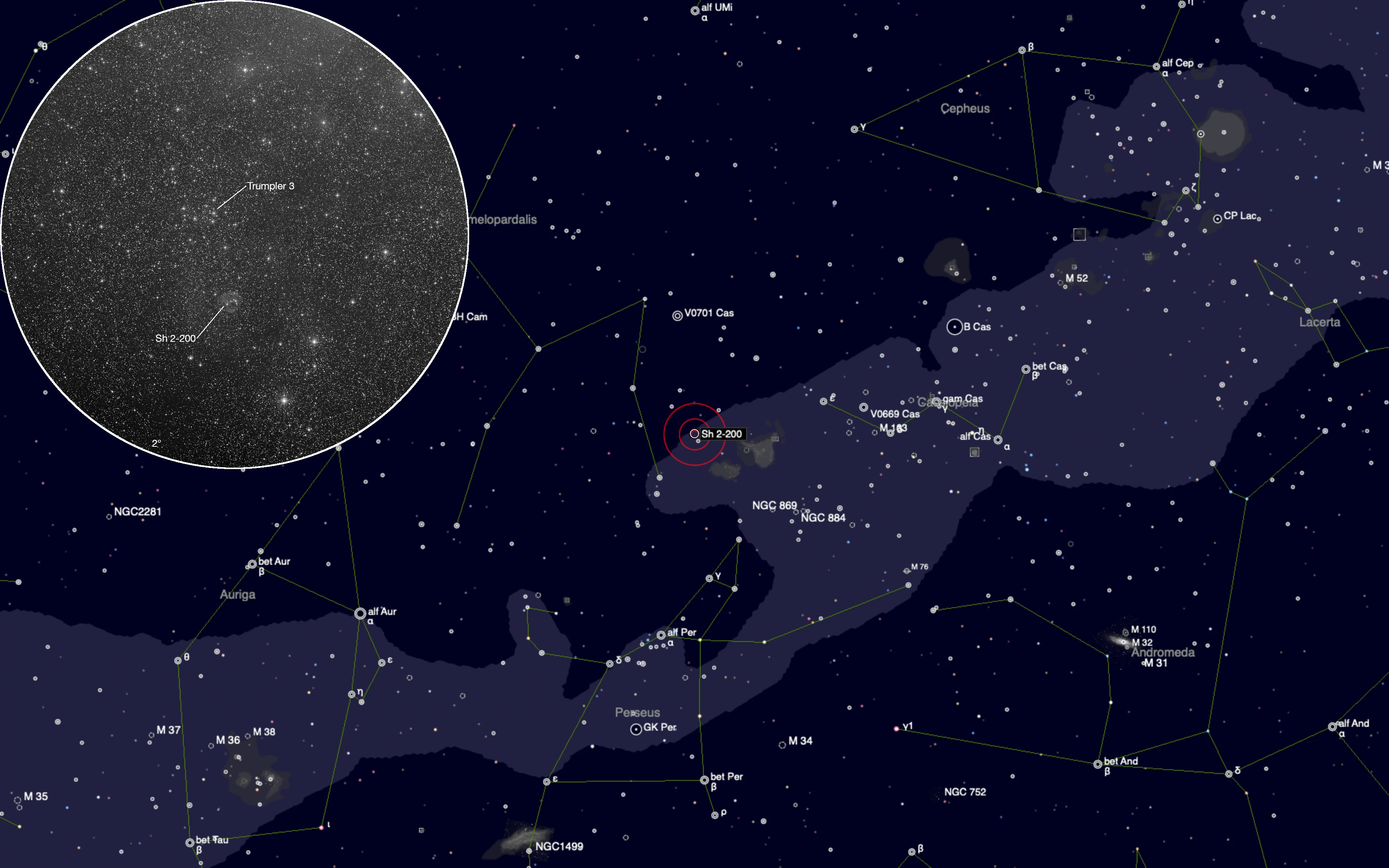
The nebulae Sh 2-200 and open Cluster Trumpler 3 are located in the constellation [UNKNOWN]. On 23 September it is in opposition to the Sun and culminates at local midnight.